LIFE BIOWET. Safe reuse of 90% of the water in hydroponic greenhouses
The European LIFE BIOWET project will develop a nature-based solution to treat and reuse drainage water from hydroponic greenhouses.
The European LIFE BIOWET project, coordinated by the University of Murcia (UMU) and funded by the European Union’s LIFE program, has begun its work with the goal of safely treating and reusing drainage water from hydroponic greenhouses, which can accumulate high concentrations of nitrates and phosphates that impact groundwater and associated aquatic ecosystems.
NOVAGRIC is participating in the project as the entity responsible for designing and building the two pilot systems to be installed in Mazarrón and San Javier, where the technology will be validated under real agricultural production conditions.
A circular technology to reduce nutrients at the source
The initiative is based on the knowledge generated over more than a decade by the University of Murcia and the Polytechnic University of Cartagena in the Mar Menor basin, where nature-based solutions have been studied to reduce nutrient pollution.
LIFE BIOWET is now applying these lessons to the treatment of drainage water from hydroponic greenhouses, using a two-stage treatment model designed to reduce the nutrient load before it reaches aquifers, riverbeds, or sensitive aquatic ecosystems.
In hydroponic farming, plants grow on an inert substrate and are supplied with a nutrient solution that provides water and essential nutrients in a controlled manner. This system increases productivity and improves control over growing conditions, while reducing water use. However, the resulting drainage water must be properly managed to prevent the accumulation and release of nutrients into the environment.
Objectives of LIFE BIOWET
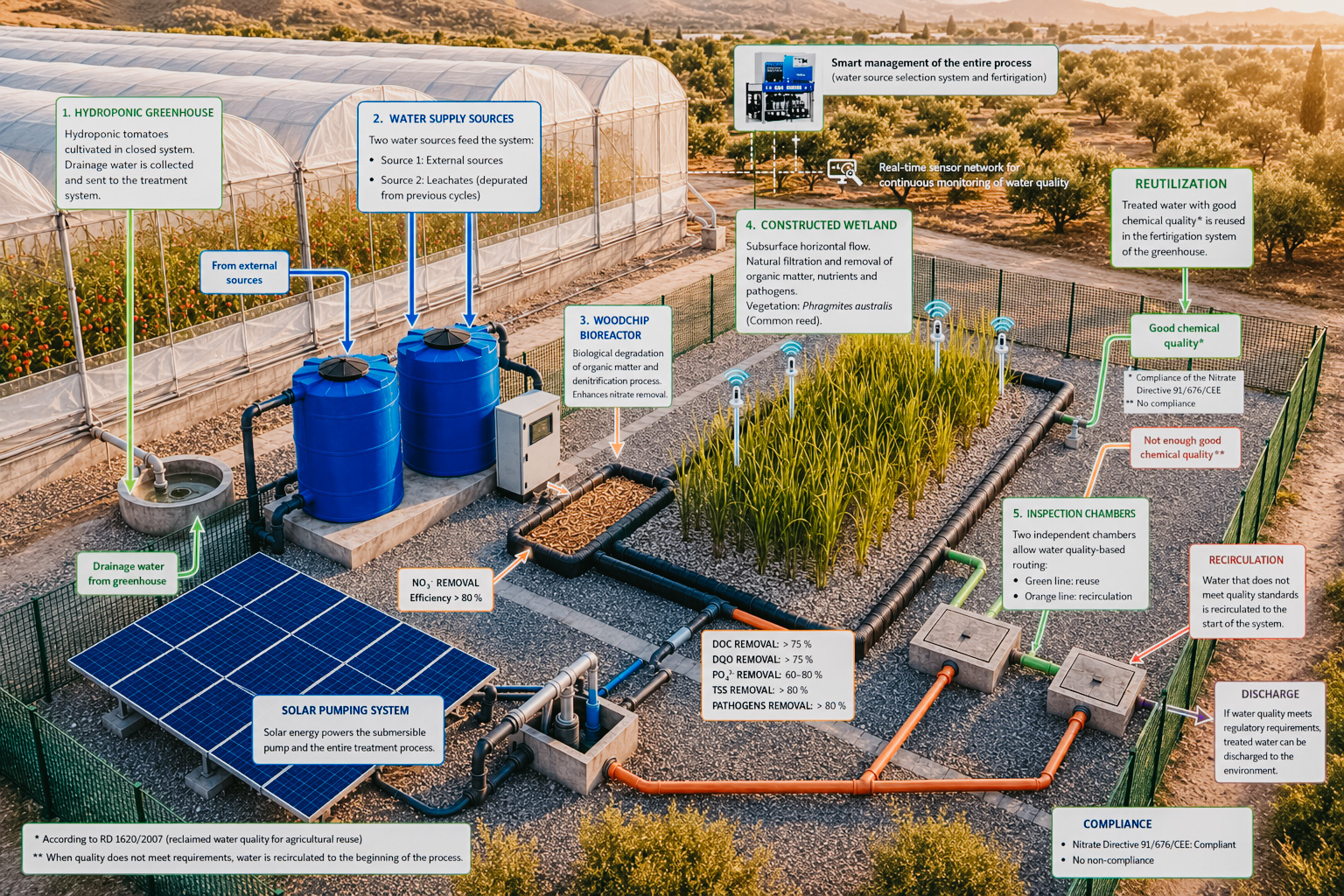
The main objective of LIFE BIOWET is to demonstrate the technical and environmental feasibility of a system capable of safely treating and reusing drainage water from hydroponic greenhouses. The proposed solution combines two treatment stages:
Wood Chip Bioreactors
In the first stage, the wastewater passes through bioreactors where the activity of denitrifying microorganisms helps reduce the nitrate load.
Artificial subsurface-flow wetlands
The water then flows through artificial wetlands, where the combination of plants, substrate, and microbial communities completes the purification process.
This second phase helps remove other potential contaminants, such as phosphorus, excess organic matter that may be generated by bioreactors, and pathogenic organisms, thereby improving the final water quality and facilitating its safe reuse.
NOVAGRIC’s Role in LIFE BIOWET
Within the consortium, NOVAGRIC will be responsible for transforming the scientific design into an operational infrastructure that can be applied under real-world agricultural production conditions.
The company will design and build the two pilot systems to be installed in greenhouses in the Region of Murcia, specifically in San Javier and Mazarrón.
Their work includes sizing the hydraulic system, integrating the bioreactors and wetlands, designing the sensor network for real-time water quality monitoring, and installing valves that will allow for switching between reusing treated water and safely discharging it when conditions require it.
“We’ve been working for years on treating wastewater from hydroponic crops, and with BIOWET we’re taking it a step further: a complete, autonomous, and remotely monitored system—a nature-based solution ready to be replicated on other farms,” explains Juan Pardo, R&D director at NOVAGRIC.
For his part, Fulgencio Pujante, NOVAGRIC’s technical manager for fertigation, highlights the importance of the system’s ability to adapt to the day-to-day management of a farm:
“Drainage water from a hydroponic greenhouse can reach very high salinity levels, and BIOWET is also a water management tool for use right at the greenhouse. It allows you to decide at any given moment whether to reuse that water for irrigation. This makes it applicable to real-world operations.”
With more than 45 years of experience in fertigation, water treatment, and technology applied to agriculture, NOVAGRIC brings to the project technical expertise already developed in other European water-focused initiatives, such as LIFE AQUEMFREE and LIFE AGREMSOIL.
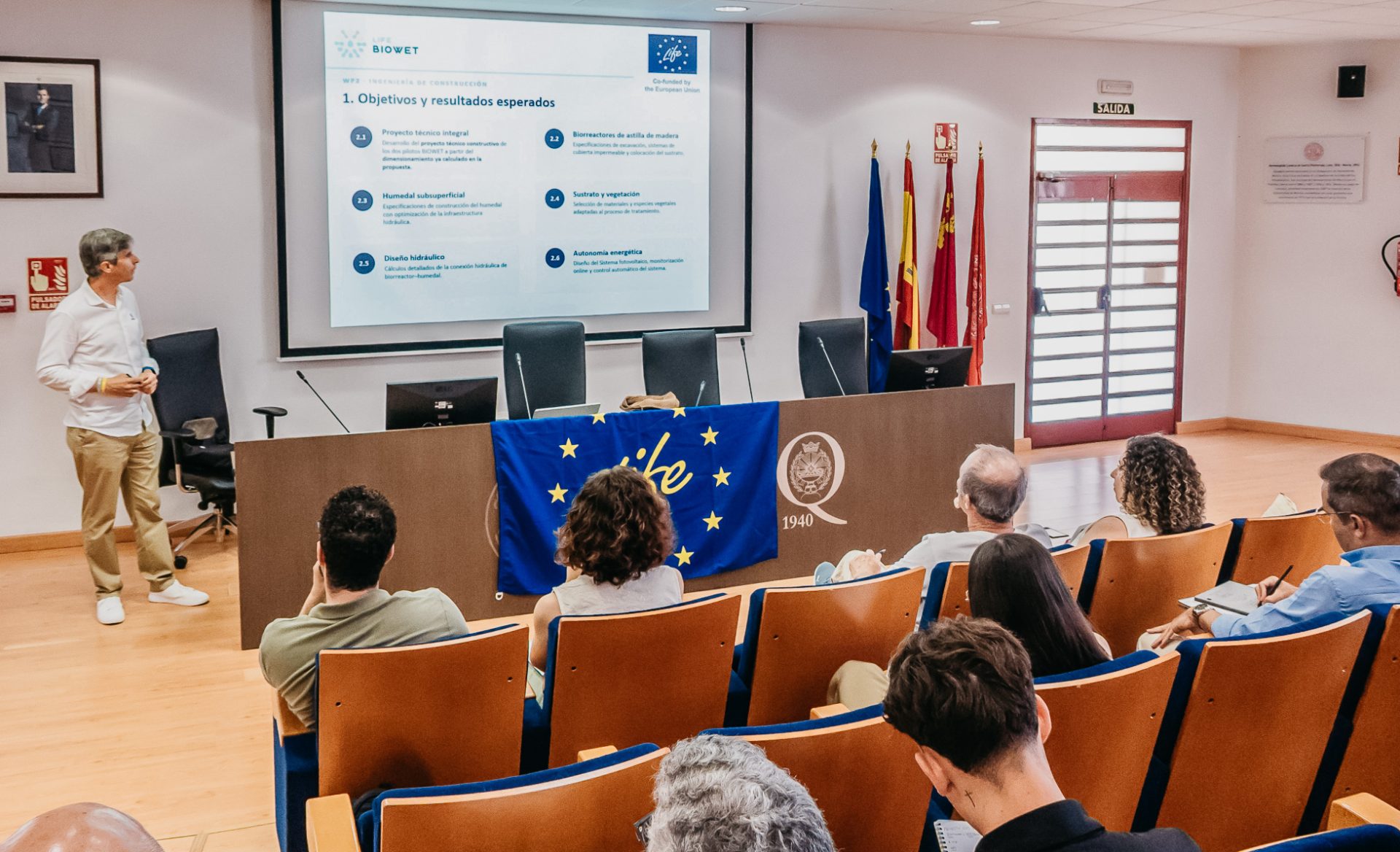
Two pilot projects in San Javier and Mazarrón to validate the system in the field
During the project, two complete pilot systems will be built, operated, and evaluated in greenhouses in the Region of Murcia.
One of them will be located at the El Mirador Agricultural Demonstration and Technology Transfer Center in San Javier, with a treatment capacity of 1 m³/day. The second will be installed at Grupo Paloma in Mazarrón, with a capacity of 10 m³/day.
These two systems will allow up to 93% of the drainage water to be recycled, reduce the combined fresh water demand of both farms by 23%, and eliminate more than 13.5 metric tons of nitrates per year.
At the European level, water savings could exceed 300,000 m³ per year, reducing the risk of pollution and eutrophication in water bodies such as aquifers, rivers, lakes, and marine ecosystems.
“The system is designed to operate using gravity and solar photovoltaic energy, without the need for a connection to the power grid. This approach reduces energy requirements and facilitates its application in agricultural settings, especially on farms where water efficiency and sustainability are key factors,” says Rosa Gómez Cerezo, full professor of Ecology at the University of Murcia and project coordinator.
A solution aligned with Europe’s water challenges
LIFE BIOWET contributes to European goals regarding circular economy, water reuse, protection of water resources, reduction of nitrate pollution, and adaptation to climate change.
In addition, the integration of artificial wetlands into agricultural landscapes can help increase biodiversity and strengthen the role of nature-based solutions within protected agriculture.
The project involves the University of Murcia, the Polytechnic University of Cartagena, NOVAGRIC, ASETAGA, Grupo Paloma, and CDTA El Mirador. It has a total budget of €2,317,291.51 and is co-financed by the European Commission through the LIFE program, call for proposals LIFE-2025-SAP-ENV, and will run through June 2030.
Related Posts



 Company